


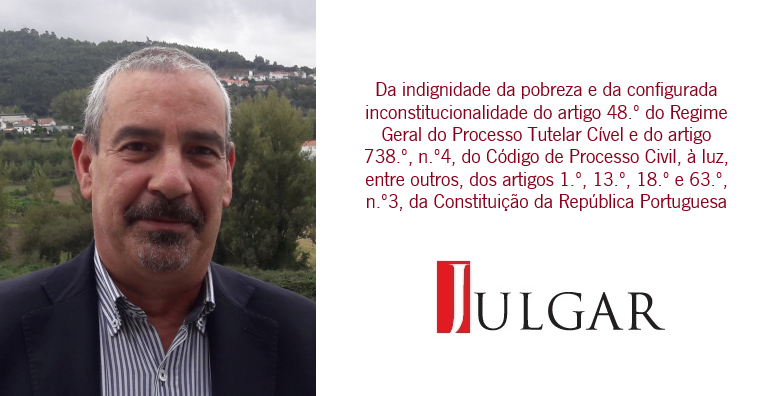
JusGov researcher Jorge Martins Ribeiro has just published the article “Da indignidade da pobreza e da configurada inconstitucionalidade do artigo 48.º do Regime Geral do Processo Tutelar Cível e do artigo 738.º, n.º4, do Código de Processo Civil, à luz, entre outros, dos artigos 1.º, 13.º, 18.º e 63.º, n.º3, da Constituição da República Portuguesa [The indignity of poverty and the configured unconstitutionality of article 48 of the General Regime of the Civil Custody Procedure and of article 738, no. 4, of the Code of Civil Procedure, in the light, among others, of articles 1, 13 , 18 and 63, no. 3, of the Constitution of the Portuguese Republic]” published at JULGAR Online.
Jorge Martins Ribeiro’s article addresses a complex and always topical issue: the limit of the untouchable income when the credit emerges from alimony and its (in)compatibility with the preservation and protection of the person’s dignity.
The article is available in open access through the following link.
JusGov researcher Jorge Martins Ribeiro has just published the article “Da indignidade da pobreza e da configurada inconstitucionalidade do artigo 48.º do Regime Geral do Processo Tutelar Cível e do artigo 738.º, n.º4, do Código de Processo Civil, à luz, entre outros, dos artigos 1.º, 13.º, 18.º e 63.º, n.º3, da Constituição da República Portuguesa [The indignity of poverty and the configured unconstitutionality of article 48 of the General Regime of the Civil Custody Procedure and of article 738, no. 4, of the Code of Civil Procedure, in the light, among others, of articles 1, 13 , 18 and 63, no. 3, of the Constitution of the Portuguese Republic]” published at JULGAR Online.
Jorge Martins Ribeiro’s article addresses a complex and always topical issue: the limit of the untouchable income when the credit emerges from alimony and its (in)compatibility with the preservation and protection of the person’s dignity.
The article is available in open access through the following link.